Showing posts with label Social Studies. Show all posts

Monday, May 31, 2010

Advertising

Advertisement by: Nicholas.
What is it trying to do?
Convince you to buy Heinz sauce.

Who is the target audience?
Anybody.

Why is this ad so effective?
Because it is funny and goes well with the motto.

Friday, May 21, 2010

Advertisment

Symbolism:
Most ads show symbolism as an object standing for what their advertising. This ad, however, uses reverse symbolism; using what their advertising (PSP) to stand for something else (Handcuffs).
Body Language:
The body language of the police show that they are attentive and fixated to solving the problem at hand. The body language of the man is similar, showing that he is fixated on the PSP.

Camera Angles:
The camera angle of this ad does not specifically highlight anything, instead shooting the scene from a point where everything can be seen clearly.

Special Effects:
There are no obvious special effects in this ad, though the city in the background may be added in or Computer-generated.

Lighting And Colour:
The whole ad is pretty well lit up, even though it is set near night, thanks to lights on the police car and in the background.

Beauty And Social Standing:
No real models appear in this ad, though the police man in the foreground is obviously a high ranked officer.
Layout And Graphics:
The actual PSP that is being advertised is small compared to the ad as a whole, allowing the every detail of the scene to be seen.

Tuesday, March 30, 2010

The Plastiki

The Plastiki is a new boat that floats using 12, 500 recycled plastic bottles. It will be on a trip from San Fransisco to Sydney to raise awareness of plastic bottles left in the ocean. 1 million sea birds and 100, 000 marine mammals die by becoming tangled in or eating rubbish left in the ocean each year.

Being 60 feet in length and weighing 12 tons, the Plastiki has many modern sailing devices and also has eco-friendly systems such as solar panels, wind turbines and bicycle generators.It will take approximately 3 months to reach Sydney and the crew will visit a few environmental hotspots en route.
The crew will only be eating food from a can and fruit and will only be drinking rainwater. Everyone on board is a strong supporter of reuse, reduce, recycle and rethink. Good luck Plastiki!
Tuesday, January 26, 2010

What I know about Haiti

1. The main causes for Haiti's poor state before the earthquake is bad politics and government, not much schooling and such a large population for such a small country.

2. Haiti is the poorest country in the western hemisphere and the 4th poorest in the world.

3. Haitians were slaves of France until 1791, when the Haitians made a reveloution and killed 150,000 french, the most ever killed in a revelotion.

4. In 1802, Nepolion sent an army of 20,000 frenchmen to recapture Haiti.

5. After all of that it must be very hard for an over-populated country to rebound.

Monday, January 18, 2010

Haiti Update


Haiti's status has not improved over the last week. Now the shock of the earthquake is over and people are rushing to help and causing chaotic situations.
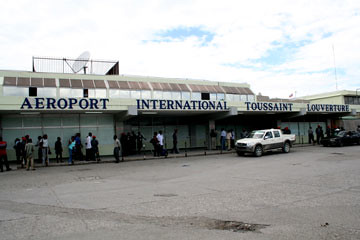
Such as the situation at Haiti airport. With places for 18 planes and only one runway, the 17 countries trying to have help sent to Haiti are finding it difficult to get to the ground. The picture to the left is of Haiti airport, or what it used to look like.

Friday, January 15, 2010

Earthquake in Haiti


In Haiti, 3 days ago, there was a massive earthquake that leveled many buildings. Haiti is a small island located in the Caribbean sea. It is near the island of Cuba and shares an island with the Dominican Republic. The Haiti capital of Port-au-Prince was feared to be hit the worst with around 50, 000 thought dead.
The picture above shows many people who have lost their homes. Many people and celebrities from all over the world are donating money to th red cross service, who are helping give these people shelter.

Tuesday, November 24, 2009

Water Questions 2

1. (Q) List the main reasons for water scarcity.
(A) Low rainfall, variations in climate, land degradations, population growth and water pollution.

2. (Q) What is a drought? What type of hardships do you think that a drought could cause if you were living in a village in a poor country such as Ethopia?
(A) A drought is when there is little or no rainfall and water scarcity in a large area. Hardships would be problems with washing and quenching thirst.

3. (Q) How does land degradation affect the supply of fresh water?
(A) It stops infiltration and creates run-off, thus transforming more fresh water from rain into salt water in the ocean.

4. a) (Q) What is El Nino?
(A) The strong winds that occur when the wind reverses over the Pacific.
b) (Q) Why does El Ninooften cause drought in Australia?
(A) Wind blows away storm clouds and water vaper in the air from Australia.

5. Observe the map showing the global effects of El Nino in 1982-83.
a) (Q) What effects does El Nino have on the availability of fresh water?
(A) El Nino takes away a lot of water from south east asia and Tasmania.
b) (Q) Name the countries and describe the problems that arose from decreased rainfall caused by El Nino.
(A)Indonesia; more air pollution and forest fires, Philippines; drought, Papua; drought and famine, Australia; drought.

Sunday, November 15, 2009

Water Treatment Plant

As part of grade 6's 'water' unit we visited a water treatment plant. There we walked around the plant and learnt how they cleaned the water from the river.
Our first station was the filters. Water flowed into the water plant from the river and flowed through a filter to take out all of the large pieces of junk in it. It then went on to flow through a finer filter which took out all the tiny pieces of junk.

The second station was where special chemicals were mixed with the water to create floc. Floc is a combination of dirt in the water that the special chemicals make coagulate. The floc floats to the water.

Station number three was where all of the water flow into large pools to let the floc settle. Once it has floated to the bottom of the pool the floc is called sediment.

Station four is where chlorine is added. Chlorine kills most diseases and dirt. The disinfected water then flows out through a filter which removes all remaining chlorine and surviving diseases.

Our final station, station five, was a room with a few vials and chemicals where water is tested to see if it was potable, which means able to drink. Here we compared the dirty water with the clean water and saw the difference.

After the tour of the water plant we saw a movie about how to save water. In all it was an educational field trip.

Wednesday, November 11, 2009

Water Questions

1.(Q) What percentage of the world's supply of water is fresh water?
(A) 2.5%

2.(Q) Where is the world's supply of freshwater found?
(A) In ice, rivers, lakes, the atmosphere and ground water.

3.(Q) Even though the supply of fresh water is abundant it is still a problem. Why?
(A) We do not capture enough rain water.

4. Observe the map of world average annual precipitation (opposite).
a)(Q) Describe the changes in rain fall that occur as you move from the southern to the northern tip of Africa.
(A) The land starts with a low amount of rainfall, then in the centre of Africa there becomes more rainfall and up at the northern tip there is again, little rainfall.
b)(Q) Describe the changes in rainfall that occur as you move from the western to the eastern tip of Australia along the Tropic of Capricorn.
(A) For two thirds of the way rainfall is scarce, but as you reach the eastern side rainfall is more common caused partly by the Great Dividing Range.

5. Observe the map above of water availability per person.
a)(Q) Which parts of the world appear to have a large amount of water available per person?
(A) The northern end of continents seem to have the most water per person.
b)(Q) Which parts of the world appear to have a small amount of water per person?
(A) The northern end of Africa seems to have the lowest water per person rate.

6. Observe the diagram of water use.
a)(Q) What are the main uses of water?
(A) Agricultural and industrial uses are the two main uses of water.
b)(Q) Which uses have increased the most over the last century?
(A) Agriculture and Industrial uses are the two water uses that have increased the most over the last century.

Saturday, November 7, 2009

Bintaro Lama

As part of grade 6's water unit, we visited Bintaro Lama Kampung and learnt how they purify their water.

We split into groups and visited 3 stations. My group's first station was 'water quality'. One way of showing how clear water is was to pour water into a thin cylinder with a cross or circle on the bottom. Then you look through the top and see how clearly you can view the cross or circle.

A way of getting rid of dirt in some water is to run it through a 'sand filter'. The sand filter that Bintaro Lama owned was a large barrel with layers of sand and gravel in it. When poured in the top of the barrel the water first had to seep through 45cm of fine sand. Proceeding that was 5cm of fine gravel and then 10cm of large gravel. Once water has seeped through the whole barrel it would come out the other end, with most of the dirt stuck in the sand or gravel.

The last station was a way of killing bacteria in water. The inhabitants of Bintaro Lama cleaned water bottles with soap and then rinsed them. The bottles were then filled with water and left on a roof of a house to be in full view of the sun's rays. All bacteria would burn and die after the water was left on the roof for 6 hours.

Lastly we learnt a hand-washing jingle before heading back to the buses. It was amazing to learn how many ways to clean water a simple kampung like Bintaro Lama has.

Saturday, October 31, 2009

The Water Cycle


Evaporation:
The graphic to the left shows H2O flying into the air. The H2O (or water as we shall call it) actually turns into a gas first. Water in gas form is called vapor. Vapor soars into the air, higher and higher until it is cooled.


Condensation:
To the left you can see a lovely graphic of a cloud.
When water vapor is cooled it becomes a liquid again. Water then floats on air and becomes fog or clouds.


Perspiration:
A graphic of rain to the left is linked to perspiration.
When a cloud is submitted to very cold air it will rain. All of the little water droplets that were riding on the air fall to the ground as rain. If submitted to extremely cold air, water can freeze and fall to Earth as snow or hail.


Infiltration:
To the left is a graphic of mud. When water hits the soil as rain it can create mud. Once water hits the ground it seeps into the earth. This is called infiltration. Soon it will find its way to the sea, which is where most water is evaporated. Then the cycle starts again.

Thursday, September 3, 2009

Earthquake

Earthquake

On the 2nd of September, 2009 an earthquake hit Java. This gives me another opportunity to mention nature's balance with humans (see Taiwan Environment).

Jakarta is in the ring of fire and so is likely to have an earthquake. The earthquake was weak in Jakarta but a bit outside of the city, there has been reports of at least 44 people dead. Some houses in Jakarta are weak and fell down during the earthquake.

This earthquake did not cause mudslides, such as typhoon morocat did because the ground in Jakarta is flat, not hill-covered like Taiwan. This shows how natural disasters work in different areas. I also mentioned that many people died. This shows how people work with the natural disasters. But not as many people died as in Taiwan due to the lack of mountains.
All this shows how the environment, natural disasters and people work together in different ways.

Wednesday, August 19, 2009

Taiwan enviroment

In August 2009, Taiwan was hit by typhoon Morocat. In my class at JIS this gave us a great chance to look at the environment and people involved as it ties in to our social studies unit.

When Morocat hit, Taiwan had the worst typhoon in fifty years. When Morocat hit, Taiwan had over two metres of rain! When Morocat hit, buildings, including the hotel shown to the left, were destroyed. All this is because of the environment and the people who live in it.

When Taiwan was flooded, the water rushed extremely fast, which is what destroyed towns and buildings. If Jakarta was flooded, however, the water level would slowly rise. This is because Jakarta is flat and the water would just build up. But Taiwan is mountainous and when the water hits the top of a mountain, and rushes downhill, the water comes with tremendous force.
In the case of the above hotel, the water dug into the earth below the hotel until it fell over.

Another natural disaster caused by Morocat were mudslides. The mountains around Taiwan are covered with a layer of dirt. When the rain falls, this dirt slides downward and creates a mudslide.
Both natural incidents above killed many people, which wouldn't have happened if people didn't live in Taiwan. This shows how people and the environment work together.